


 My account
 My Reserves
by Lettie Fardon
“What a privilege to represent José and his wines in the UK. His incredible talent, self-belief, and unrelenting quest for quality are impossible not to admire.”
 José arrived five minutes late, I paced around the courtyard in front of the bodega, trying to hide from the relentlessly powerful midday sun. It was so peaceful that I worried I’d got the wrong day. He arrived cool, calm, and collected, hands grubby with the dirt from the vineyards where he had been seconds before.
We jumped in his car to see one of the 24 small plots he owns, chatting about El Bierzo and how he first met our buyer, Nicola, on the way. I was curious about what had made him choose to settle in Bierzo, originally hailing from Barcelona and having spent time all over the world. After an extensive period in Bordeaux, he wanted to make something special, age-worthy, and Spanish. After visiting sites in Navarra, Barcelona, Priorat, Rioja, and many more, he decided El Bierzo had the greatest potential and promise.
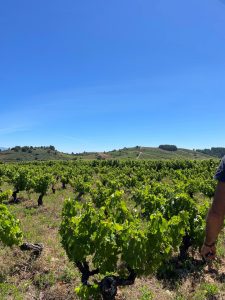 El Bierzo is small but perfectly formed, with just 3,000 hectares under vine in contrast to Rioja’s 120,000. It is a veritable patchwork of soil types, offering variety and uniqueness to each plot. Receiving double the annual rainfall of Priorat, at around 800-900 mm, it has the potential to adapt to changing times. Lastly, and perhaps most importantly, it boasts a wealth of old vines, with some planted around 1904.
Quality is at the forefront of everything José does. Each year he adds lime to help deacidify the soil, which becomes more acidic over time. This is just one example of his long-term dedication and care for the land; this is not a five-year project. The first plot we visited was tiny, just a few rows of vines. Wildflowers grew between the rows, soon to be mowed to help the vines as competition for water becomes scarcer. He farms organically but does not care for certification, like many small producers who simply do not have time for the paperwork.
With so many old vines, I was interested to find out what he does if he needs to replace them. The answer was as considered and conscientious as I’d expected. He plants American rootstocks, which establish in the first year. He then grafts a massal selection from the oldest vines onto the rootstock. José explained (and I believe him) that he can taste the difference between each vine. The Mencía clone does not come from a nursery; each vine is different, unique.
Bierzo has come on in leaps and bounds since José moved to the region in 2004. It is now recognised as one of Spain’s top emerging regions, often compared to having the finesse of Burgundy and the age-worthiness of some of the top wines of the world. This movement must be credited in part to Álvaro Palacios and his nephew Ricardo Pérez Palacios, but also to producers like José in their unwavering quest for perfection. Some of José’s neighbours are planting Godello, arguably the trendy thing to do as more drinkers seek white wine. I might as well have slapped him in the face with a wet fish when I enquired if he might do the same. After a moment of silence, he replied, “I’d sooner do one thing really well.”
Mencía is part of the regional draw. Also known as Jaen, it is likely to have come from Portugal’s Dão region. Its perfumed elegance and complexity – especially when from old vines – are some of the contributing factors which have led to a Priorat-esque revolution of the region. It needs careful care around the point of harvest as its delicate skin results in a risk of botrytis but otherwise, it is relatively low maintenance. In the winery, it is prone to reduction, so maceration is incredibly gentle. Bunches are whole-bunch pressed to minimise the tannins which have a risk of overpowering the delicate fruit. Two years in barrel and three years in bottle before release ensure the wine has time to settle and arrive on your table the way José would intend it to be drunk.
We headed back to the cellar via the new winery, which will leap into action for the first time this year – around the 8th of September, as the harvest commences. Talk about night and day. José’s current cellar is small, dark, and not unlike a garage. The new bodega towers above it, designed by an architect and brought to life by an industrial engineer from a neighbouring village. Each part of the winemaking process occurs in a different room, compartmentalised to allow for the perfection and attention to detail José pours into making each bottle. A larger, temperature-controlled barrel room will allow him to keep the wine in barrel for a few months longer if he wishes, wings unclipped by the constraints of his smaller cellar. It will be a joy to see what he can achieve in this brand-new Aladdin’s cave of a winery.
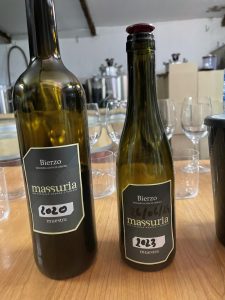 We tasted the soon-to-be-released 2020 vintage, which was everything I’d expected and more. Ripe red cherry, liquorice, and sweet spice. Blackberries, plums, and forest fruit aromatics. Vivacious floral notes with a herbal undertone of rosemary and thyme. Supple, ripe, fine tannins and fresh, clean acidity left a lingering finish.
After this, he had a treat for me: the 2023 vintage, still in barrel. José explained it sat somewhere between the model vintages of ’18, ’22, or ’16 and those in between. It was cooler, crunchier in fruit profile. Red fruit dominated, with barely a hint of those dark fruits that leapt out of the 2020. Rain towards the end of August gave it an earthiness I liked -smoky, savoury, and more herbal and perfumed than fruity. A totally different wine, but with recognisable flavourful intensity, lithe body and a finish that continues to dance on the tongue long after the wine is gone.
What a privilege to represent José and his wines in the UK. His incredible talent, self-belief, and unrelenting quest for quality are impossible not to admire.
Buy José’s 2016 Massuria, Bodegas Mas Asturias from Bierzo on-line here
“Double decanted. Lively crimson. Smooth, very obvious fruit with definite, spicy tang. Lots of fun. Exuberantly fruity but not too sweet.” – Jancis Robinson MW