


 My account
 My Reserves
By Amanda Skinner
As a wine merchant, you are often asked what your favourite wine is. An almost impossible question to answer, akin to being asked to choose your favourite child, especially when you have had a career as many decades long as I have! I usually duck the question by saying that if I was limited to two regions to drink for the rest of my days that I would probably choose Burgundy and Piedmont, or Pinot Noir and Nebbiolo, if I was really pushed to make that choice. I was very lucky to have the privilege of representing some very venerable Piemontese growers in the 1990s and got to know the great Angelo Gaja, Roberto Voerzio and Bruna Giacosa well whilst being their UK agent as well as working later with Elio and Gianluca Grasso, Jeff Chilcott at Marchesi di Gresy, Paola and Marco Oberto at Ciabot Berton, Raffaella Bologna and Norbert Reinisch at her family winery, Braida, and Alessandro Locatelli at Rocche Costamagna. The region, its people and its food captured my heart.
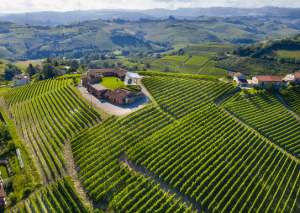 Flying into Milan or Turin and driving north with the majestic backdrop of The Alps clearly visible and snow-clad for much of the year, crowning the horizon is a journey guaranteed to lift your mood. We always stay in Alba which was, frankly, at that time the nearest town to the vineyards with a choice of hotels and, of course, a selection of fantastic restaurants to choose from after a hard day of tasting. In spite of the rising popularity of these noble wines across the world, Piedmont remains a region that has changed little over the years and only a few of the larger wineries have embraced the concept of attracting the wine tourist with tasting rooms and restaurants. However, whilst I would definitely recommend – and do to clients visiting Piedmont – a visit to a winery which can offer you a tour and tasting and then lunch, you can also eat the most delicious food in every village or, as in the case of the undeniably best courgette risotto that I have eaten in my life, a road-side café which really did look like the Italian equivalent of a Little Chef.
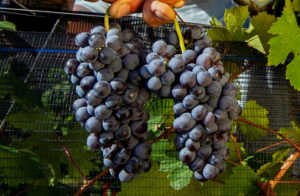 Driving up the hairpin bends, through the steep vineyards, to Barolo and Barbaresco, is not for the faint-hearted but the views when you stand on the village ramparts of those villages, as well as La Morra, Serralunga d’Alba, Castiglione Faletto and Montforte d’Alba are simply breathtaking and possibly the most stunning of all the great wine regions in the world. Barolo is known as “the King of wines and the wine of Kings” and, with Barbaresco, is made from the great Nebbiolo grape variety, named after the nebbia, or fog, which rises from the River Tarano on Autumn mornings. A late ripening variety, historically the wines were astringent and tannic with a long time spent in large Slavonian oak botti and requiring an even longer time in bottle to soften and become drinkable.
Today, with the advent of more gentle wine-making techniques, the introduction of some French oak barrel use to tame the tannins and warmer Autumns which have given the Nebbiolo the opportunity to properly ripen have combined to make wines that are altogether more drinkable and alluring earlier in their evolution. I went to a brilliant tasting of a selection of crus from various vintages from Ceretto with Alessandro Ceretto who gave a wonderful overview of the region, the family’s philosophy in the vineyard and winery and some fascinating observations on the impact of climate change in the region.
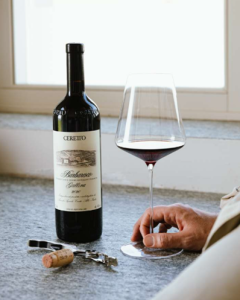 The Ceretto family, in common with many of the great wine families of the region have moved from being a négociant to buying land and making wines under their own label over a number of generations. As Alessandro said at the tasting, his Father and Uncle were lucky to be able to buy land in the 1970s and 1980s “before the boom” in Barolo and Barbaresco. Whilst the older generations very much stayed at home and followed the traditional methods in the vineyard and in their winemaking, the new generation travelled widely and gained experience in Australia, California and Bordeaux and brought all that knowledge back to Piedmont. Their feeling was that there was too much emphasis of the wines as “brands” and that an understanding of the vital role of terroir has been lost and that is where Alessandro and his siblings and cousins have focused all their energies, spending the majority of their time in the vineyards and adopting biodynamics. Piedmont is often likened to Burgundy but, in Alessandro’s view, Piedmont is more complicated with eleven different towns or zones, four different distinct soil types, a complicated topography with many different micro-climates, often within a single vineyard and widely differing altitudes. 1996 is the vintage when climate change really impacted.
In Alessandro’s Father’s time they only made single vineyard wines in great vintages which was usually a couple or three vintages per decade. Now, the quality of nine or ten vintages per decade warrants single vineyard bottling. I often say that we are fortunate to be living in an era when the quality of winemaking across the world and across the price bands has never been higher and whilst there should be serious concern over climate change, there is a silver lining in terms of grapes regularly reaching physiological ripeness and the resultant quality of the wines that we consequentially drink. Look out for our upcoming Ceretto offer if you would like to experience these joyous wines.
See our Ceretto wines collection here.