


 My account
 My Reserves
By Lettie Fardon
Due to the current situation regarding COVID-19, The Master of Wine Stage Two exams have been cancelled in 2020. It’s a tough blow for students who have invested a great deal of money, time and study over the past year, gearing up for the exam, and the new challenge will be to remain motivated. Here’s a view from Lettie Fardon, our colleague in Beirut, on studying for the coveted title.
 The MW is a devilishly tough title held by fewer than 400 people in the world. Widely regarded as the most formidable qualification in the industry, more people have successfully gone into Space! Unlike the educational body The Wine and Spirit Education Trust (WSET) the Institute of Masters of Wine is a membership body and, as such, it promises to offer personal and professional opportunities through a network of fellow Members. What it does not provide is a structured learning programme, and students are required to devise their own study plans.
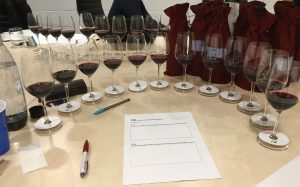
We are lucky enough to work with one of these rare Masters of Wine (MW) at Private Cellar, our very own Nicola Arcedeckne-Butler, and Laura Taylor and I are currently studying for the second element of this rather daunting programme, having successfully passed Stage One last summer. Stage Two comprises four days of exams to assess practical and theoretical knowledge, a blind tasting test of 36 wines, a dozen each morning on days one, two and three, followed by a series of essays covering five different modules, each requiring a sprinkling of global, relevant and juicy – how else will you remember them? – examples.
The Stage Two modules cover five papers:
Viticulture: anything to do with vine growing, right up to harvesting the fruit, understanding about Martin Krajewski’s use of cover crops at Clos Cantenac in Pomerol, or Esther Pinuaga’s hand pruned bush vines.
Vinification: why does Pablo de Simón of Bodegas de la Marquesa, Valserrano use small fermentation tanks to ensure soft and controlled extraction, AKA silky smooth tannins in his wines?
Handling of Wine: not the sexiest of topics, but certainly one of the most important. The most exciting part of this is a visit to a 24/7 bottling plant – it is seriously impressive.
The Business of Wine: what has happened to Fine Wine online investment over the last decade, where might it go next?
Contemporary Issues: longer essays on ‘hot’ topics in the world of wine, such as: Does wine have a significant role to play in a healthy lifestyle? This must be backed up with facts, figures, examples – the examiners’ report advised against “unsubstantiated, wild claims”.
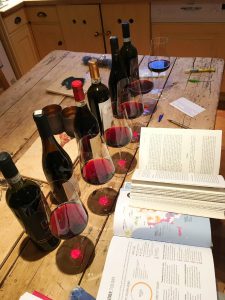 The esteemed two letters seem, at times, impossible. Even the most devoted among us have had second thoughts en route to an early morning Saturday mock paper when a lie-in would have been nice, or facing the prospect of getting to grips with pectinolytic enzymes on a Sunday night (at this point, even the hoovering starts to look appealing). But each endurance test has its reward and our fellow students are comrades-in-arms – there’s an ‘all in this together’ attitude which inspires curiosity and appetite for learning.
As momentum builds, the understanding of ‘how’ or ‘why’ someone has made something is rewarding and fascinating and let’s not forget the Practical test of 36 wines, a theory exam with a tasting element requiring physical and mental endurance. Practice doesn’t necessarily make perfect, but it does make progress in fine-tuning our taste buds and mental agility.
If we manage to make it through Stage Two, the final hurdle is the RP – a detailed research paper on a topic of our choice. This is not just the ‘final fling’ but one of the most challenging aspects of the MW as it requires motivation, many re-writes, more than a few knock backs but it can also be the most rewarding as it connects students with contacts around the world while they research a topic of genuine interest to them.
The 10% pass rate is intimidating, the challenge is immense – but if you don’t buy a ticket you can’t win the lottery. And who doesn’t want to win the jackpot?